


Date: March 20, 2015
To: Concerned Departments/Individuals
Subject: Report on Leakage of Rubber Expansion Joints in HVAC System at a Project Site in China
Summary:
On March 20, 2015, technicians from Shanghai Songjiang Vibratiob Absorber Co., Ltd. visited a project site at an undisclosed location in China and observed leakage issues with a batch of rubber expansion joints installed in the basement pump room. The following issues were identified based on on-site observations and investigations:
- Leakage from DN350 Rubber Expansion Joint:
- One DN350 rubber expansion joint installed at the outlet of the central air conditioning unit exhibited detachment. Upon arrival, our technicians found the joint dismantled and lying on the ground. The flange welded onto the pipeline had been replaced by a butterfly valve special flange by the installation team. The technician determined that the flange had been recently replaced with a butterfly valve special flange based on the fresh paint applied to the weld seam. The joint had been reinstalled with the new flange, but during repressurization, leakage occurred at the weld seam. The initial detachment and subsequent leakage were attributed to the mismatch between the inner diameter of the large diameter flange (377mm) and the inner diameter of the DN350 rubber joint (350mm), resulting in incomplete sealing and potential misalignment.
- Repeated Leakage from Reinstalled DN350 Rubber Expansion Joint:
- Another DN350 rubber expansion joint, which had been removed and reinstalled three times, was found to be leaking again during pressure testing. Despite the apparent integrity of the sealing surface, subsequent inspection revealed several layers of broken nylon cords beneath the surface, compromising the joint’s integrity. The repeated detachment and leakage were attributed to the initial use of a non-specialized flange, leading to subsequent failures.
- Loose Fastening Bolts:
- Several rubber expansion joints were found to have loose fastening bolts, as evidenced by video footage documenting the loosening condition.
- Overstretched Rubber Expansion Joints:
- Several rubber expansion joints were excessively stretched, resulting in the loss of their spherical shape. The most severe case involved a DN350 joint that had not yet undergone pressure testing but was already visibly overstretched. This condition raises concerns about the joint’s ability to function properly during operation.
- Quality Concerns and Third-Party Testing:
- Following repeated incidents of detachment and leakage, project leaders expressed doubts about the quality of our products, demanding compensation for water and labor costs. In response, our technicians proposed third-party testing to impartially assess the quality of our products. Testing parameters include burst pressure, hydrostatic pressure, and leakage tests. If testing reveals inherent product defects, the company is willing to accept penalties and cover repair expenses. However, if the products are found to be defect-free, no liability will be assumed.
Conclusion:
The issues outlined above are factual and warrant prompt attention and resolution. Our company is committed to addressing the concerns raised and is willing to collaborate with third-party testing agencies to ensure impartial evaluations and appropriate actions.
Shanghai Songjiang Vibratiob Absorber Co., Ltd.
March 20, 2016

Below is a DN350 rubber expansion joint that exhibited elongation before being pressurized:
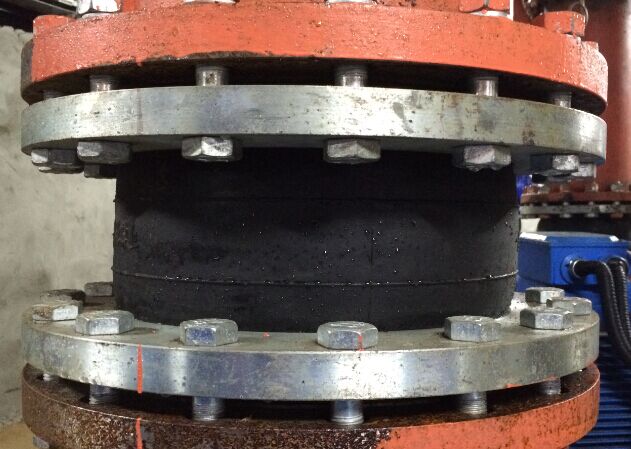
This phenomenon indicates potential issues with the installation or structural integrity of the expansion joint. Further investigation and corrective measures may be necessary to address this issue and ensure the proper functioning of the expansion joint within the system.
Understood, the information provided by the Shanghai Songjiang Factory Technical Department is for internal use only and should not be reproduced without permission. Thank you for your cooperation.
Related link: Rubber Expansion Joint Installation Instructions


