


Shanghai Songjiang Vibration Absorber Group Co., Ltd.’s official website presents information on the differences between common stainless steels 304, 304L, 316, and 316L. Our factory specializes in producing stainless steel metal hoses, bellows compensators, and stainless steel flange rubber expansion joints. Let’s take a look at the differences between stainless steels 304, 304L, 316, and 316L.
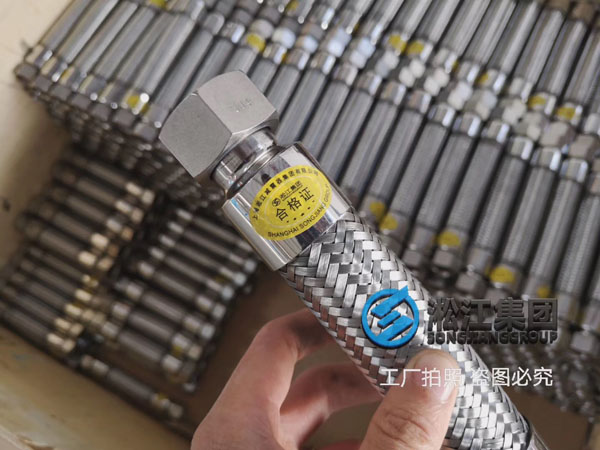
Insight into the Differences Between Common Stainless Steels 304, 304L, 316, and 316L Stainless steel metal hoses are commonly used in applications where the working medium has certain corrosive properties. The steel grades commonly used are 304, 304L, 316, and 316L. This article will introduce the differences between these four stainless steels, hoping to be helpful for future work.
304 Stainless Steel: 304 stainless steel is the most common steel grade and is widely used due to its excellent corrosion resistance, heat resistance, low-temperature strength, and mechanical properties. It has good formability for stamping, bending, etc., with no hardening phenomenon after heat treatment (non-magnetic, usable temperature -196°C to 800°C). Applications: Household items (class 1 and 2 tableware, cabinets, indoor pipelines, water heaters, boilers, bathtubs) Automobile parts (windshield wipers, mufflers, molded products) Medical equipment, building materials, chemical, food industry, agriculture, ship components
304L Stainless Steel (L stands for low carbon): As a low-carbon version of 304 steel, its corrosion resistance is similar to 304 in general conditions, but after welding or stress relief, its resistance to intergranular corrosion is excellent. It can also maintain good corrosion resistance without heat treatment, usable temperature -196°C to 800°C. Applications: Used in outdoor machinery with high requirements for intergranular corrosion resistance in chemical, coal, and petroleum industries, as well as heat-resistant parts in building materials and parts with difficult heat treatment.
316 Stainless Steel: 316 stainless steel, due to the addition of molybdenum, has excellent corrosion resistance, atmospheric corrosion resistance, and high-temperature strength, making it suitable for use in harsh conditions. It has good machinability (non-magnetic). Applications: Equipment used in seawater, chemical, dye, paper, oxalic acid, fertilizer production; photography, food industry, facilities in coastal areas, ropes, CD rods, bolts, nuts.
316L Stainless Steel (L stands for low carbon): As a low-carbon series of 316 steel, it has the same characteristics as 316 steel, with excellent resistance to intergranular corrosion. Applications: Products with special requirements for intergranular corrosion resistance. 316L and 316 Stainless Steel: 316 and 316L stainless steels are molybdenum-containing stainless steels. The molybdenum content in 316L stainless steel is slightly higher than that in 316 stainless steel. Due to the molybdenum in the steel, its overall performance is better than that of 310 and 304 stainless steels. In high-temperature conditions, when the concentration of sulfuric acid is less than 15% and greater than 85%, 316 stainless steel has a wide range of applications. 316 stainless steel also has good resistance to chloride corrosion, so it is usually used in marine environments. The maximum carbon content of 316L stainless steel is 0.03, which can be used in applications where annealing cannot be performed after welding and maximum corrosion resistance is required.
Chemical Composition Corrosion Resistance: 316 stainless steel has better corrosion resistance than 304 stainless steel and exhibits good corrosion resistance in the production process of pulp and paper. Additionally, 316 stainless steel is resistant to corrosion in marine and corrosive industrial atmospheres. In general, there is not much difference in the resistance to chemical corrosion between 304 and 316 stainless steels, but there may be differences in some specific media. Initially developed stainless steel is 304, which is more sensitive to pitting corrosion under specific conditions. Adding an extra 2-3% molybdenum can reduce this sensitivity, giving rise to 316 stainless steel. Additionally, this additional molybdenum can also reduce the corrosion of certain hot organic acids. 316 stainless steel has almost become the standard material in the food and beverage industry. Due to the global shortage of molybdenum and the higher nickel content in 316 stainless steel, the price of 316 stainless steel is higher than that of 304 stainless steel. Pitting corrosion is a phenomenon mainly caused by corrosion deposits on the stainless steel surface, as the absence of oxygen prevents the formation of a chromium oxide protective layer. Especially in small valves, the likelihood of deposits on the valve plate is small, so pitting corrosion rarely occurs. In various types of water media (distilled water, drinking water, river water, boiler water, seawater, etc.), the corrosion resistance of 304 stainless steel and 316 stainless steel is almost the same, unless the chloride ion content in the medium is very high, in which case 316 stainless steel is more suitable. In most cases, there is not much difference in the corrosion resistance between 304 stainless steel and 316 stainless steel, but there may be significant differences in some cases, requiring specific analysis. In general, valve users should have a clear understanding, as they will choose the material of the container and pipeline according to the medium. We do not recommend recommending materials to users.
Heat Resistance: 316 stainless steel has good oxidation resistance at temperatures below 1600°C for intermittent use and below 1700°C for continuous use. It is not recommended for continuous operation of 316 stainless steel within the range of 800-1575°C, but when used continuously outside this temperature range, the stainless steel has good heat resistance. The performance of carbide precipitation of 316L stainless steel is better than that of 316 stainless steel and can be used within the above temperature range. Heat Treatment: Annealing at temperatures between 1850-2050°C, followed by rapid annealing and rapid cooling. 316 stainless steel cannot be hardened by overheating.
Welding: 316 stainless steel has good welding performance and can be welded using all standard welding methods. Depending on the application, 316Cb, 316L, or 309Cb stainless steel filler rods or electrodes can be used for welding. To achieve the best corrosion resistance, the welded section of 316 stainless steel needs to be annealed after welding. If using 316L stainless steel, post-weld annealing is not required.
Mechanical Properties: Among all steels, the yield point of austenitic stainless steel is the lowest. Therefore, from a mechanical properties perspective, austenitic stainless steel is not the best material for valve stems because the diameter of the valve stem needs to be increased to ensure a certain strength. The yield point cannot be increased by heat treatment but can be increased by cold forming. Magnetism: Due to the widespread use of austenitic stainless steel, people have been misled into thinking that all stainless steels are non-magnetic. For austenitic stainless steel, it is generally understood to be non-magnetic, and this is indeed the case with quenched forged steel. However, cold-formed 304 stainless steel may exhibit some degree of magnetism. For cast steel, if it is 100% austenitic stainless steel, then it is non-magnetic.
Differences Between Common Stainless Steels 304, 304L, 316, and 316L Low Carbon Stainless Steel: The corrosion resistance of austenitic stainless steel comes from the chromium oxide protective layer formed on the metal surface. If the material is heated to temperatures between 450°C and 900°C, the structure of the material will change, and chromium carbide will form along the grain boundaries. This prevents the formation of the chromium oxide protective layer along the grain boundaries, thereby reducing the corrosion resistance. This type of corrosion is called “intergranular corrosion.” To combat this corrosion, 304L stainless steel and 316L stainless steel were developed. Both 304L and 316L stainless steels have lower carbon content, which prevents the formation of chromium carbide and thus intergranular corrosion. It should be noted that higher susceptibility to intergranular corrosion does not necessarily mean that non-low-carbon materials are more prone to corrosion. In high-chloride environments, this sensitivity is also higher.


