


Shanghai Songjiang Vibration Absorber Co., Ltd. official website introduces information about the emergency pool for rubber expansion joint factory accidents. Songjiang Group specializes in the production of high-end rubber expansion joints, and the factory was relocated to Shuangdian Town Industrial Zone, Nantong City in 2019. To protect the environment, an emergency pool has been constructed, also sharing with peers about the emergency pool for rubber expansion joint factory accidents.
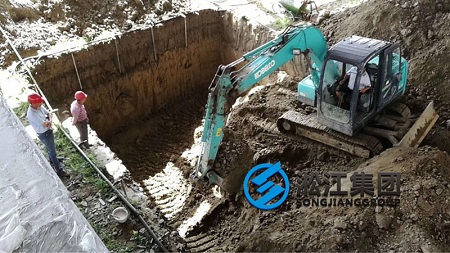
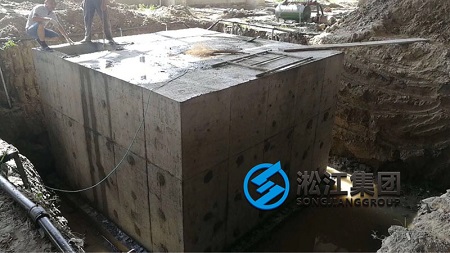
Introduction to Emergency Pool for Rubber Expansion Joint Factory Accidents
In the event of an environmental accident, the emergency pool is designed to collect leaked substances, with a capacity ensuring containment of the maximum leakage volume. The pool must be corrosion-resistant to prevent groundwater contamination.
The concept of an emergency pool was initially proposed following the pollution accident at Jilin Petrochemical. Subsequently, according to the provisions of GB50283-2009 “Design Specification for Environmental Protection of Chemical Construction Projects,” emergency accident pools should be set up for chemical construction projects. However, there is no clear indication regarding the calculation method for emergency accident pool capacity. According to current methods for determining emergency accident pool capacity, it may not necessarily prevent wastewater from overflowing onto the ground in the event of an accident.
Currently, there are three main bases for calculating emergency accident pool capacity: one is the Guideline for Design of Emergency Measures for Water Pollution Control (2016) issued by Sinopec; another is the “Design Specification for Environmental Protection of Chemical Construction Projects” (GB 50483-2009); and the third is the Technical Requirements for Prevention and Control of Water Pollution under Accident Conditions (Q/SY1190-2009) issued by China National Petroleum Corporation, which is similar to the Guideline. Since the Guideline provides more specific methods with parameters that can be implemented, the capacity of the emergency accident pool is generally calculated according to the provisions of the Guideline. Many designers directly use the result calculated according to the formula in the Guideline as the effective volume of the accident pool (neither the Guideline nor the Specification directly stipulates safety margin requirements for the volume of the accident pool).
Two important factors in determining emergency accident pool capacity are: firefighting water consumption and the amount of rainwater that may enter the accident pool in the event of an accident. However, neither of these quantities calculated according to current design specifications represents the maximum value.
Firefighting water consumption: According to current firefighting design specifications, the product of firefighting water supply flow rate and fire duration is calculated, and the firefighting water supply flow rate specified in the current firefighting specifications is the minimum flow rate that must be guaranteed by design. Therefore, the firefighting water consumption obtained by multiplying these two quantities is the minimum water consumption that must be guaranteed by design. Consequently, the actual firefighting water consumption during a fire may be much larger than the water quality designed according to the specifications.
Regarding the amount of rainwater that may enter the accident pool in the event of an accident, there are currently two calculation methods: one is according to the Guideline, which is the average daily rainfall for the year; the other is according to the “Specification,” which specifies the “maximum local rainfall.” However, according to the design theory of rainwater drainage systems, the amount of rainfall during a certain period is determined by the catchment area and the design intensity of the rainstorm. In rainstorm intensity calculations, there is an important parameter—the design return period, which is determined based on factors such as the importance of the drainage area and economic conditions, and theoretically can be infinite. The “maximum local rainfall” is only relatively maximum, not absolute maximum, and there may actually be rainfall greater than it.
Current firefighting design specifications explicitly state that the replenishment time of firefighting pools should not exceed 48 hours, meaning that firefighting needs to consider the time required to empty the accident pool in response to a second fire within a short period. The current specifications or guidelines do not make such requirements, and the time to empty the accident pool may exceed 48 hours due to limitations in sewage treatment capacity of the enterprise or external contracted units. Therefore, if the accident pool cannot completely contain the wastewater generated during the second fire, it may overflow.
Therefore, based on the current calculation basis for the capacity of emergency accident pools, it is entirely possible that the determined accident pool may not be able to contain the actual amount of wastewater generated during an accident, leading to overflow. Therefore, it is preferable for the accident pool to be located at the lowest point of the factory area, and it should be clearly stated in the emergency response plan that measures such as preparing sandbags at the openings in the factory perimeter wall are to be taken to prevent wastewater from the accident pool from flowing into external water bodies. Additionally, there should be provisions for corresponding temporary storage facilities (such as organized tanker transportation) in case of overflow. Furthermore, the design capacity of the drainage network may face similar situations, and it may temporarily overflow due to the inability to adapt to the actual drainage flow rate. Moreover, when the accident pool is higher than the inlet of the accident pool, as it also rises, the drainage capacity of the drainage network gradually decreases (the actual slope of the water decreases), increasing the possibility of temporary accumulation of water on the ground. Therefore, it is also required that the emergency accident pool be located as close as possible to the end of the rainwater pipeline with a large diameter.
Implementing confined space operations must:
- Develop feasible plans.
- Close the operation area and set up safety warnings, conduct equipment safety checks and safety isolation, perform mechanical ventilation and gas detection, determine the operating environment, and confirm entry after ensuring environmental safety, with monitoring throughout the entire process by a supervisor outside the confined space.
- Operators must correctly select and wear personal protective equipment, with continuous monitoring by a supervisor throughout the entire process from outside the confined space.
- Confined space operations have prominent characteristics of secondary accidents in the event of an accident, and enterprises should strengthen emergency management in this regard.
Emergency management for confined space operations should:
- Develop practical emergency plans.
- Equip necessary emergency rescue equipment.
- Conduct regular drills to enhance the emergency rescue capabilities of relevant personnel.
- Immediately alert in case of an accident, prohibit blind rescue, and prevent the further expansion of accidents.
- When rescuers carry out rescue operations, they should prioritize their own protection.
Emergency pools are also known as accident buffer pools or emergency accident pools, referring to facilities designed to effectively receive polluted water such as drainage from devices and firefighting water in the event of an accident, preventing the pollution of external environments by accident wastewater. In the actual process of accident handling, the collection of accident wastewater through emergency pools minimizes the probability of secondary water environmental pollution events caused by accidents, ensuring environmental safety.
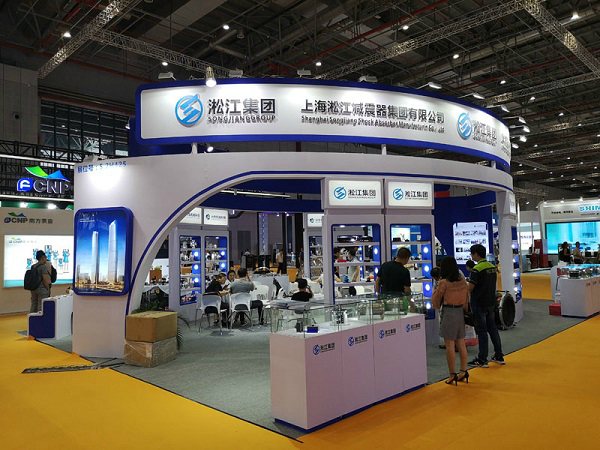
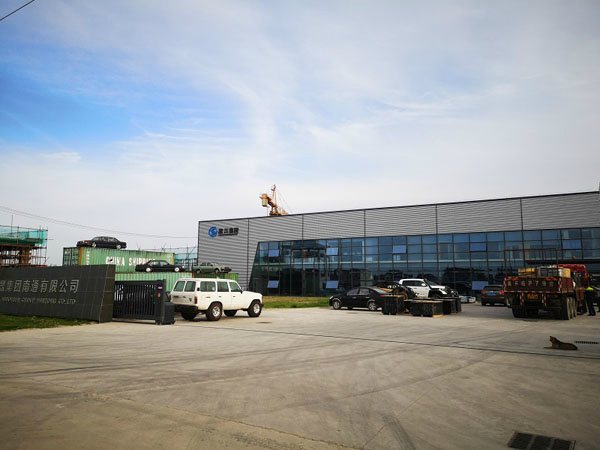
Related link:Shanghai Songjiang Company Introduction


